What to Look for in an LKG School in Horamavu
Choosing an LKG school is an important step in your child’s early education. At this age, children are beginning to become more independent, communicate more confidently, make friends, and understand how a classroom works. For parents searching for an LKG school in Horamavu, the choice can sometimes feel confusing because many schools may appear similar from the outside.
The right LKG school is not simply the one with the most activities or the most attractive campus. Parents should look at the teachers, classroom environment, learning approach, safety, daily routine, play opportunities, individual attention, and overall comfort of the child.
LKG should be a place where children enjoy learning rather than feel pressured to perform. A good school gives children opportunities to explore, ask questions, play, create, communicate, and gradually build the skills they will need for the next stage of education.
Start With Your Child, Not the School
Before visiting different schools, take a moment to think about your child’s personality.
Does your child enjoy being around other children? Are they comfortable in new places, or do they need some time to settle? Do they love drawing, stories, music, building things, outdoor play, or talking?
There is no right or wrong personality.
Understanding your child’s nature can help you decide what kind of school environment may suit them.
For example, a quiet child may benefit from a patient teacher who gives them time to participate. A very active child may need regular opportunities for movement and outdoor play. A child who enjoys asking questions may do well in a classroom where teachers encourage curiosity.
The best school is one where your child can gradually become more confident without feeling that they have to change who they are.
Look at How LKG Children Are Taught
One of the most important things to understand is the school’s teaching approach.
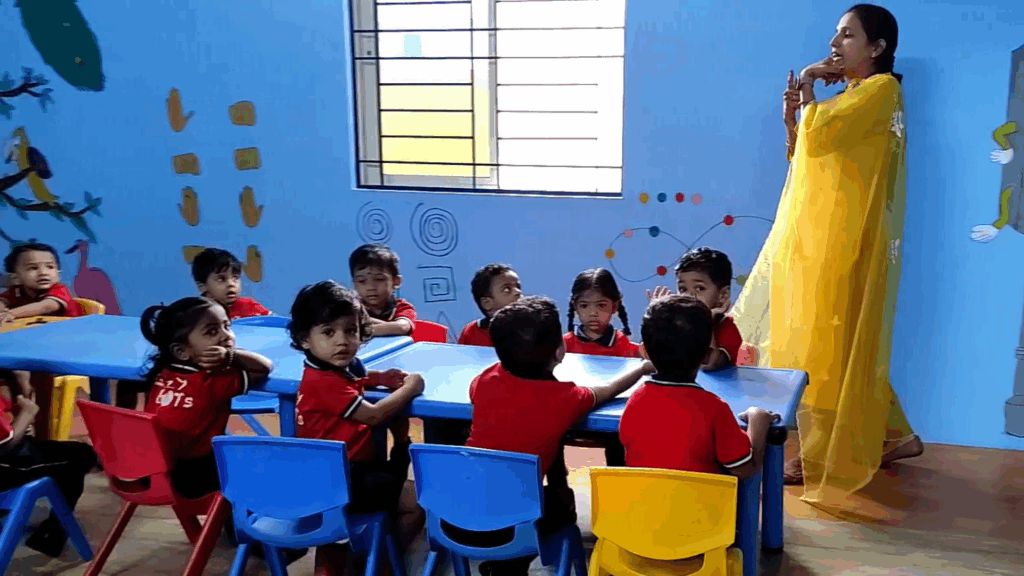
LKG children are still very young. They learn naturally through observation, conversation, repetition, movement, stories, games, music, art, and hands-on activities.
This means learning does not always have to happen with a pencil and notebook.
For example, children can learn counting while playing with blocks. They can develop language skills through storytelling. They can understand colours and shapes through art activities. They can practice communication during group discussions and pretend play.
When you visit an LKG school in Horamavu, ask the teacher how they introduce new concepts.
You can ask:
- How do children learn letters and sounds?
- How are numbers introduced?
- Are stories and activities part of the classroom?
- How much time do children spend sitting and writing?
- Are children encouraged to ask questions?
- What happens when a child finds a concept difficult?
The answers will help you understand whether the classroom is focused on meaningful learning or simply completing activities.
Pay Attention to the Teachers
A good teacher can make a huge difference in a young child’s school experience.
During a school visit, observe how teachers interact with children.
Do they speak patiently? Do children feel comfortable approaching them? Do teachers listen when a child talks? How do they respond when a child makes a mistake?
LKG children need teachers who understand that young children can sometimes become distracted, emotional, shy, or restless.
A teacher should be able to guide children without making them afraid of learning.
It is also useful to ask about the teachers’ experience with early childhood education. You can ask how the school supports teachers and how they communicate with parents about a child’s progress.
Check the Classroom Environment
Don’t just look at whether the classroom is colourful.
Look at how the space is actually used.
Are there age-appropriate books? Are learning materials within children’s reach? Is there space for group activities? Can children move around safely? Are their drawings or projects displayed?
A good LKG classroom should feel welcoming and organized.
Children should have opportunities to participate rather than simply sit quietly for long periods.
You can also observe the children if classroom observation is permitted. Their behaviour can give you useful clues.
Do they look engaged? Are they interacting with the teacher? Are they playing or working together?
You don’t need to judge the school based on one five-minute observation, but it can give you a general feeling about the environment.
Safety Should Always Be a Priority
For parents, safety is one area where it is better to ask questions rather than make assumptions.
When visiting an LKG school, ask about the school’s safety procedures and supervision.
Find out how children are handed over during drop-off and pick-up, how visitors enter the premises, and what happens during an emergency.
You can also ask about:
- CCTV monitoring
- Staff supervision
- Visitor access
- Emergency procedures
- First-aid arrangements
- Outdoor play supervision
- Hygiene practices
- Pick-up authorization
Look around the school as well. Notice whether classrooms, stairs, play areas, entrances, and washrooms appear suitable for young children.
A school should be able to explain its safety practices clearly.
Make Sure There Is Time for Play
LKG is not only about preparing children academically.
Play is an important part of early childhood.
Through play, children learn to share, communicate, cooperate, solve simple problems, follow rules, use their imagination, and develop physical coordination.
When comparing an LKG school in Horamavu, ask about the amount and type of play included in the daily routine.
Children can benefit from both indoor and outdoor activities.
Building blocks, puzzles, pretend play, drawing, music, movement games, ball games, and outdoor exploration can all provide valuable learning experiences.
The important question is not simply whether a school has a playground. Ask whether children actually get regular opportunities to use it.
Look at the Daily Routine
Young children generally feel more comfortable when their day follows a predictable rhythm.
Ask the school what a typical LKG day looks like.
A balanced routine may include classroom learning, stories, creative activities, movement, outdoor play, meals or breaks, and social interaction.
The exact schedule will differ between schools, but children should have some variety throughout the day.
If children spend too much time on one type of activity, they may lose interest or become tired.
A good routine allows children to learn while also having time to move, play, rest, and interact.
Think About Language and Communication
LKG is an important stage for language development.
Children should have regular opportunities to speak, listen, describe things, ask questions, and express their thoughts.
Storytelling can be especially useful.
A teacher might show a picture and ask children what they see. Children may talk about a story, describe an object, participate in role play, or answer simple questions.
These activities help children become more comfortable speaking in a group.
Parents should ask how the school supports children who are shy or less confident about speaking.
A child does not need to become an excellent public speaker in LKG. The goal is to help them gradually feel comfortable communicating.
Ask How the School Handles Different Learning Speeds
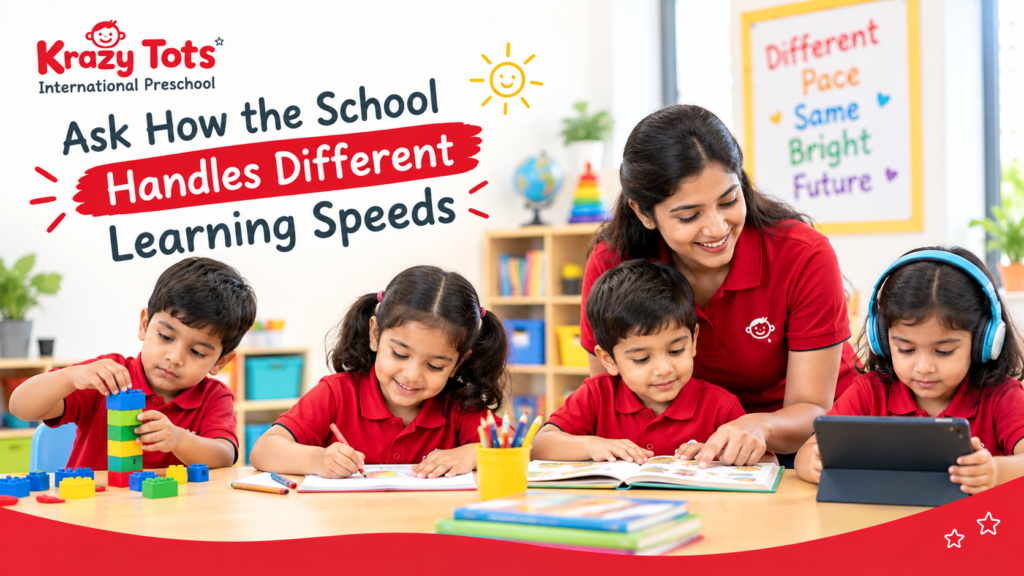
Children do not all learn at the same speed.
One child may recognize letters quickly but take longer with writing. Another may be confident with numbers but need more time with language.
This is normal.
Ask the school how teachers support children who need additional practice.
A good classroom should not make children feel bad because they are slower than someone else.
Teachers can use repetition, games, individual guidance, hands-on activities, and small-group work to help children understand concepts.
This is one reason why individual attention matters.
Consider Class Size and Individual Attention
The number of children in a classroom can affect how much attention teachers can give each child.
Ask about the usual number of students in an LKG classroom and the teacher support available.
More important than simply finding the smallest class is understanding whether teachers can recognize individual children’s needs.
Can a teacher notice when a child is struggling?
Can they help a child who is shy?
Can they encourage a child who has lost interest?
These everyday interactions are an important part of early childhood education.
Look at the School’s Approach to Discipline
Discipline is necessary in any classroom, but the way it is handled matters.
Young children are still learning how to manage emotions, wait for their turn, share, follow instructions, and solve disagreements.
Ask how teachers respond when children misbehave or have conflicts.
A supportive approach teaches children what they can do differently instead of simply making them afraid of making mistakes.
You can ask:
“What happens if two children have an argument?”
“How do you handle a child who refuses to participate?”
“How do you help children follow classroom rules?”
The response can tell you a lot about the school’s overall philosophy.
Don’t Forget About Independence
An LKG classroom should help children become more independent in small ways.
Children can learn to keep their belongings in the right place, open their water bottles, manage their lunch boxes, wash their hands, clean up after activities, and ask for help when necessary.
These may seem like small things, but they help children develop confidence.
Parents should look for a school that gives children opportunities to try things themselves instead of having adults do everything for them.
Of course, teachers should provide help when a child needs it. Independence does not mean leaving a young child to manage everything alone.
Think About the Location and Daily Travel
If you are looking for an LKG school in Horamavu, location is naturally an important consideration.
A school that is close to home can make daily life easier, but don’t choose a school based on distance alone.
Think about the actual journey during school hours.
Bengaluru traffic can vary significantly depending on the time of day. A journey that looks short on a map may take considerably longer during busy periods.
Consider how your child will feel after travelling to and from school every day.
A manageable commute can make mornings less rushed and give your child more time for sleep, play, and family activities.
Understand the Fees Clearly
Before finalizing a school, ask for a complete explanation of the fee structure.
Don’t look only at the main tuition fee.
Ask whether there are separate charges for admission, books, uniforms, activities, transportation, events, meals, or other services.
A clear fee structure helps you compare schools fairly.
Remember that a higher fee does not automatically mean a better school. Instead, consider what your child receives in return and whether the overall environment matches your expectations.
Visit the School With Your Child
A website can give you information, but a school visit gives you a much better understanding of the environment.
If possible, take your child with you.
Watch their reaction when they enter the campus.
Are they curious?
Do they want to explore?
Do they seem uncomfortable?
Do they respond positively to the teachers?
Your child may not be able to explain everything, but their reactions can provide useful clues.
At the same time, don’t expect your child to make the final decision. Parents should consider their child’s reaction alongside practical and educational factors.
Ask Questions Before You Decide
Don’t feel shy about asking questions during a school visit.
You can ask about the curriculum, teachers, daily routine, safety, activities, communication with parents, school timings, holidays, fees, and what happens if your child needs additional support.
You can also ask whether parents are allowed to observe a classroom or speak with a teacher before admission.
The right school should be willing to explain how it works.
Consider Krazy Tots International Preschool
Parents comparing early-learning options can also consider Krazy Tots International Preschool for their child’s preschool journey.
Krazy Tots provides a play-based learning environment where children get opportunities to learn through classroom activities, stories, creative experiences, group interaction, and physical play. The school also has a spacious campus and a large covered play area that gives children room for active experiences.
For parents considering an LKG school, visiting the campus and speaking with the teachers is a useful way to understand whether the environment is suitable for their child.
What to Look for in an LKG School in Horamavu FAQs
What should parents look for in an LKG school?
Parents should consider the teaching approach, teachers, classroom environment, safety, play opportunities, daily routine, individual attention, communication, fees, and location.
Is play important in LKG?
Yes. Play supports children’s social, physical, emotional, creative, and problem-solving skills. LKG should provide a healthy balance between structured learning and play.
How important is the teacher in an LKG classroom?
Very important. Young children need patient and supportive teachers who understand early childhood development and can help children feel comfortable while learning.
Should I choose an LKG school close to home?
A convenient location can make daily travel easier, but distance should be considered alongside teaching quality, safety, classroom environment, and your child’s comfort.
What questions should I ask during an LKG school visit?
Ask about the curriculum, daily routine, teacher experience, class size, safety procedures, play activities, fees, parent communication, and how the school supports children who need additional help.
How can I know if my child will be comfortable at the school?
Visit the school with your child if possible. Observe how they react to the classroom, teachers, activities, and surroundings. Their reaction can provide useful clues, although children may still need time to adjust after admission.
Final Thoughts
Choosing an LKG school in Horamavu is about finding a place where your child can learn, play, communicate, and grow with confidence.
Don’t feel pressured to choose a school simply because it is popular or because someone else recommends it. What works well for one child may not necessarily be the right choice for another, Krazy Tots International Preschool.
Visit the schools you are considering. Observe the classrooms. Speak with teachers. Ask about safety and daily routines. Understand the teaching approach and fees. Most importantly, think about how your child feels in the environment.
The right LKG experience should make children curious about the world around them and comfortable enough to ask questions, make mistakes, try again, and enjoy learning.
When children associate school with positive experiences, they can carry that confidence with them as they move into UKG and primary school.