Best Age to Start Nursery School in Bengaluru: A Complete Guide for Parents
Choosing the right age to start nursery school is an important decision for parents. Every child develops at their own pace, so there is no single age that is perfect for everyone. However, most children are ready to begin nursery between 2.5 and 3.5 years of age, depending on their social, emotional, communication, and self-help skills.
For parents in Bengaluru, the decision can also depend on the preschool’s admission age, school timings, distance from home, teaching approach, and the child’s comfort with a new environment. Instead of focusing only on age, parents should look at whether their child is showing signs of preschool readiness.
If you are searching for a nursery school in Bengaluru, this guide will help you understand the ideal age, readiness signs, admission considerations, and how to make the transition easier for your child, Krazy Tots International Preschool.
What Is the Best Age to Start Nursery School?
In general, 2.5 to 3.5 years is a common age range for starting nursery school.
Some children may be comfortable starting soon after turning two and a half, while others may need more time before they are ready for a structured preschool environment. Both situations can be completely normal.
At this age, children are beginning to become more independent. They may enjoy playing with other children, listening to stories, singing songs, exploring new activities, and following simple instructions.
Nursery is not simply about preparing children for academic learning. It is also about helping them become comfortable outside the home, communicate with others, develop routines, and learn through play.
The right question is therefore not just:
“How old is my child?”
It is also:
“Is my child ready for the preschool experience?”
Why Do Many Children Start Nursery Around 3 Years?
Around the age of three, many children begin developing skills that help them adjust to a nursery environment.
They may start communicating their needs more clearly, following simple directions, participating in group activities, and interacting with other children.
A nursery classroom may introduce children to activities such as:
- Storytelling
- Rhymes and songs
- Drawing and colouring
- Blocks and puzzles
- Sand and water play
- Outdoor games
- Simple art and craft
- Music and movement
- Group activities
- Basic number and language concepts
These activities can help children develop communication, motor, social, and thinking skills in an enjoyable way.
However, children do not suddenly become “ready” on their third birthday. Development happens gradually, which is why parents should consider the individual child rather than following age alone.
Signs Your Child May Be Ready for Nursery
Age is only one part of preschool readiness. Your child’s everyday behaviour can provide useful clues.
Your Child Can Communicate Basic Needs
A child does not need to speak perfectly before starting nursery. However, it helps if they can communicate simple needs such as wanting water, needing the toilet, feeling hungry, or asking for help.
Even children who are still developing their language skills can attend preschool. Teachers can support communication through conversations, songs, stories, and activities.
Your Child Shows Interest in Other Children
Does your child watch other children playing? Do they try to join them? Do they enjoy being around cousins or children at the park?
These can be positive signs.
Children do not need to share perfectly or play cooperatively all the time. At this age, learning to interact with others is itself part of the preschool experience.
Your Child Can Follow Simple Instructions
Being able to understand simple directions can make the transition easier.
For example:
“Come here.”
“Keep the toys in the box.”
“Let’s wash our hands.”
“Sit with the group.”
Children gradually learn to follow classroom routines with practice.
Your Child Is Becoming More Independent
Small self-help skills can make preschool more comfortable.
Your child may be able to:
- Eat some food independently
- Drink water from a cup or bottle
- Put away toys
- Remove simple footwear
- Wash or clean their hands with help
- Tell an adult when they need something
They do not need to do everything independently before nursery. Preschool itself is a place where children develop these abilities.
What If My Child Is Not Fully Potty Trained?
This is a common concern among parents.
Potty training develops differently for every child. Some children become toilet independent before nursery, while others are still learning.
Parents should check the individual preschool’s toilet-training policy before admission. More importantly, avoid making your child anxious or ashamed about toilet training.
A supportive environment can help children gradually become more independent.
Is Starting Nursery at 2.5 Years Too Early?
Not necessarily.
A 2.5-year-old child can be ready for nursery if they are comfortable spending some time away from their parents, can communicate basic needs, and show curiosity about new environments.
However, a younger child may need a slower transition.
For example, the preschool may initially have shorter sessions or allow parents to gradually help the child adjust, depending on the school’s policies.
Parents should pay attention to their child’s behaviour rather than assuming that every 2.5-year-old will respond in the same way.
Is Starting Nursery at 3.5 Years Too Late?
No.
Starting at 3.5 years is not automatically late.
Some children benefit from having additional time at home before entering preschool. They may need more time to develop confidence, communication, independence, or separation readiness.
What matters is that the child gets opportunities to learn and interact with others during this period.
Parents should also check the admission requirements of the school they are considering because age criteria can vary between preschools.
What Should Parents Consider When Choosing a Nursery in Bengaluru?
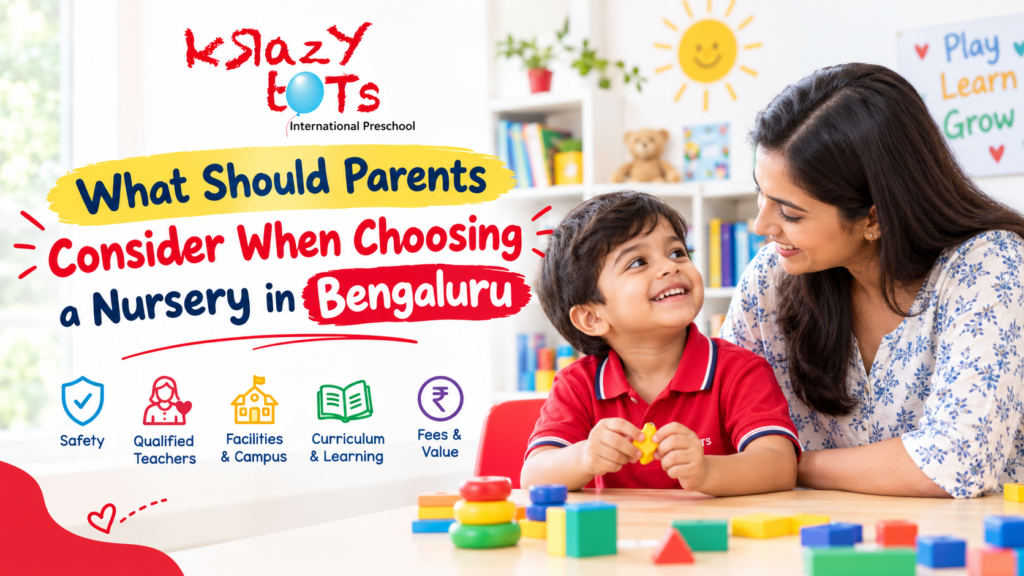
Bengaluru has many preschool options, so choosing a school involves more than checking the admission age.
The first thing parents should consider is the environment.
Visit the preschool and observe the classrooms. Are children comfortable? Do teachers speak patiently with them? Is there enough space for movement and play?
The teacher-child relationship is especially important at the nursery level because children are still developing emotional security outside the home.
Look at the Learning Approach
Young children learn best when they can explore and participate.
A good nursery program can include stories, songs, games, art, movement, sensory activities, outdoor play, and age-appropriate learning experiences.
Parents should ask how the school balances learning and play.
Check Safety and Hygiene
Safety should be a major part of your preschool decision.
During a school visit, ask about:
- CCTV surveillance
- Entry and exit procedures
- Staff supervision
- Emergency procedures
- Hygiene practices
- Toilet facilities
- Child pickup policies
- Outdoor play safety
Parents should also ask how the preschool handles minor injuries or emergencies.
Consider the Distance From Home
Bengaluru traffic can make daily travel challenging.
A preschool that is reasonably close to home can make the daily routine easier for both the child and parents. Shorter travel time can also mean more time for rest and family activities.
This is particularly important for younger children who may become tired after a long commute.
How Important Are Preschool Timings?
Timings should fit your child’s routine as well as your family’s schedule.
A child who is beginning nursery may still need a regular nap and plenty of rest.
Parents should understand:
- School start and end time
- Number of hours children spend at school
- Meal or snack arrangements
- Nap or quiet-time arrangements
- Daycare availability, if required
If both parents work, combining preschool and daycare may be convenient, but parents should still make sure the child gets enough rest and relaxed family time.
How Can Parents Prepare a Child for Nursery?
The transition becomes easier when children know what to expect.
A few weeks before school begins, parents can start introducing a simple daily routine.
Wake your child around the same time each morning. Give them breakfast, allow some playtime, and introduce activities that involve sitting, listening, drawing, or following simple instructions.
You can also talk positively about school without putting pressure on your child.
For example:
“You will meet your teacher and play with other children.”
“There will be stories, songs and toys.”
Try not to repeatedly say, “Don’t cry when I leave.” This can unintentionally make children worry about separation.
Instead, keep your message calm and reassuring.
What If My Child Cries on the First Day?
Crying during the first few days of preschool is common.
A child may be entering an unfamiliar place with new adults, children, sounds, routines, and activities. Even a confident child may feel emotional during separation.
Parents should follow the school’s settling-in process and keep goodbyes calm and consistent.
Avoid disappearing without saying goodbye. A short, reassuring goodbye can help children understand that their parent is leaving but will return.
Over time, many children become more comfortable with the routine.
Nursery Is About More Than Academics
One of the biggest mistakes parents can make is choosing a nursery only because it promises early academic learning.
At this age, children need opportunities to develop many different skills.
A child who learns how to wait for a turn, communicate with classmates, complete a simple activity, put away toys, listen to a story, and express feelings is learning important life skills.
Play is also a powerful part of early childhood learning.
Through play, children can experiment, make choices, solve simple problems, develop imagination, and understand how to interact with others.
Nursery at Krazy Tots International Preschool
For parents looking for a nursery school in Bengaluru, Krazy Tots International Preschool provides an environment where young children can learn through play, activities, interaction, and exploration.
Krazy Tots has been serving children since 2012 and offers preschool programs designed around children’s early learning and development. The preschool also provides activities such as storytelling, singing, dramatics, group projects, nature walks, and outdoor games.
The campus provides space for children to move, play, and participate in activities, while trained teachers support children as they become comfortable with the preschool routine.
Parents considering nursery admission can visit the school, observe the environment, speak with teachers, and understand the program before making a decision.
For more information, visit Krazy Tots International Preschool.
Should You Start Nursery at 2.5, 3, or 3.5 Years?
There is no universal answer.
A 2.5-year-old who is confident, curious, and comfortable with short periods away from parents may be ready.
A three-year-old may be at a very comfortable stage for starting nursery.
A 3.5-year-old who needs additional time to develop independence can also begin successfully.
The most important thing is to consider the child’s development, personality, communication, independence, and emotional readiness, along with the preschool’s age requirements.
A Simple Way to Make the Decision
Before enrolling your child, ask yourself:
Does my child enjoy being around other children?
Can my child communicate basic needs?
Can my child spend some time away from me?
Does my child show curiosity about new places and activities?
Can my child follow simple instructions?
Is my child beginning to develop self-help skills?
If the answer to several of these questions is yes, your child may be ready to experience nursery.
If the answer is no, it does not mean your child is behind. It simply means they may need additional support and preparation.
Best Age to Start Nursery School in Bengaluru FAQs
What is the ideal age to start nursery school?
Most children start nursery between 2.5 and 3.5 years, although readiness varies from child to child.
Can a 2.5-year-old join nursery?
Yes. A 2.5-year-old may be ready if they can communicate basic needs, show curiosity, and gradually become comfortable away from parents.
Is 3 years a good age to start nursery?
Yes. Around three years is a common age for children to begin nursery because many children are becoming more independent and socially comfortable.
Is 3.5 years too late to start nursery?
No. Starting at 3.5 years is not too late. Some children simply need more time before they are comfortable in a preschool setting.
Should my child be completely potty trained before nursery?
Not necessarily. Requirements vary between preschools, so parents should check the school’s specific toilet-training policy.
How can I prepare my child for nursery?
Introduce a simple daily routine, encourage self-help skills, arrange opportunities to play with other children, talk positively about school, and gradually practice short periods away from parents.
What should I look for in a nursery school in Bengaluru?
Consider the teachers, safety, hygiene, learning approach, play opportunities, classroom environment, timings, location, communication with parents, and overall comfort of your child.
Final Thoughts
For most children, around 2.5 to 3.5 years is a suitable age range to start nursery school, but readiness is more important than a particular birthday.
Parents should look beyond academics and consider the preschool’s teachers, safety, learning approach, play opportunities, daily routine, location, and overall environment, Krazy Tots International Preschool.
Before making the final decision, visit the preschool and observe how children are treated. Ask questions, understand the routine, and think about whether the environment feels comfortable for your child.
The best nursery is not necessarily the one that starts children the earliest. It is the one that provides a safe, caring, engaging, and age-appropriate environment where children can learn at their own pace.