01
Hand Strength
Squeezing playdough, rolling dough and using soft sponges help children practise the hand movements needed for everyday tasks.
02
Finger Control
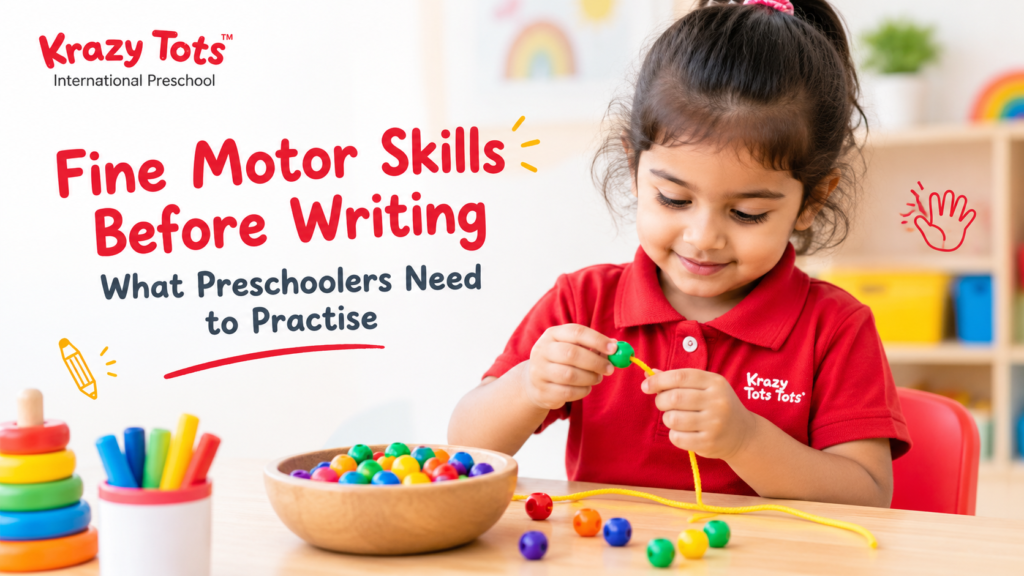
Picking up large beads, placing objects into containers and using chunky crayons encourage controlled finger movements.
03
Hand-Eye Coordination
Puzzles, stacking blocks and simple construction activities help children coordinate their hands with what they see.
04
Pencil Grip
Drawing with thick crayons, chalk and short pencils gives children opportunities to explore comfortable ways of holding writing tools.
05
Pre-Writing Movements
Drawing lines, circles, curves and zigzag patterns helps children practise the basic movements used in early writing.
06
Two-Hand Coordination
Tearing paper, opening containers and holding paper with one hand while drawing with the other help children learn to use both hands together.
More Activities to Strengthen Fine Motor Skills
Different activities practise different movements. Offering a variety of playful experiences helps children build skills without making every activity feel like a writing lesson.
Colouring
Encourage your child to colour freely using thick crayons. Focus on enjoyment and control rather than staying perfectly inside the lines.
Paper Tearing and Pasting
Let children tear paper into pieces and paste them onto a sheet to create pictures. This encourages finger strength and coordination.
Building Blocks
Stacking and connecting blocks helps children practise grasping, positioning and releasing objects accurately.
Simple Puzzles
Picking up pieces, turning them and fitting them into the correct spaces develops hand-eye coordination and problem-solving.
Sticker Activities
Peeling and placing large stickers encourages controlled finger movements and attention to detail.
Everyday Tasks
Allow children to practise opening suitable containers, turning pages, using spoons and putting away toys. Everyday routines offer valuable opportunities to develop independence.
How Parents Can Support Fine Motor Development at Home
Parents can support these skills by including simple hand activities in everyday routines.
Choose age-appropriate materials
Use chunky crayons, large blocks and suitable child-safe tools that are comfortable for your child’s developmental stage.
Keep activities enjoyable
Allow your child to explore rather than turning every activity into a task that must be completed correctly.
Encourage independence
Give your child time to turn pages, use a spoon, put away toys and manage simple dressing tasks.
Avoid forcing pencil grip
Children’s grips develop gradually. Offer different writing tools and encourage comfortable, controlled movements.
Provide regular practice
Short, enjoyable activities throughout the week can offer more opportunities for practice than occasional long sessions.
Supervise small objects
Keep beads, buttons, small puzzle pieces and other choking hazards away from young children who may put objects in their mouths.
Professional Early Childhood Learning
At Krazy Tots International Preschool, early learning includes opportunities for children to explore, create and practise important developmental skills through age-appropriate activities.
From Nursery to LKG and UKG, children gradually build skills related to drawing, pencil control, early literacy, communication and classroom independence.
Fine motor activities can be adapted to suit children’s individual abilities and developmental stages. Children should have time to practise without unnecessary pressure to write neatly before they are ready.
A balanced preschool experience combines hands-on play, creative expression, movement and early academic learning to support overall development.