20 Fun Nursery Rhymes for Kids: Songs, Learning Benefits & Activities
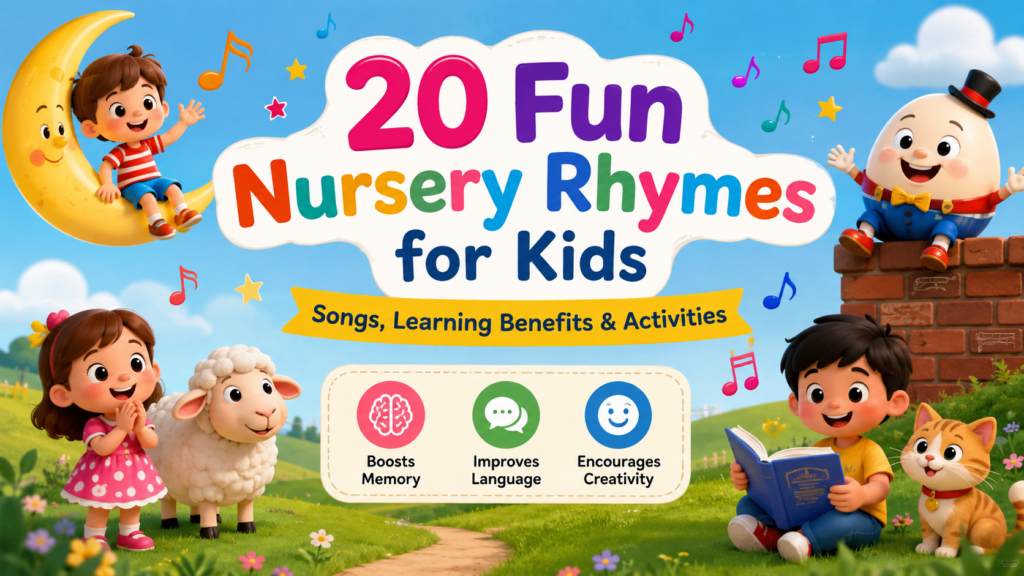
Nursery rhymes are often some of the first songs children learn. They are simple, repetitive, and easy to sing, making them a natural way for young children to learn new words, sounds, movements, and ideas.
The best nursery rhymes for kids combine singing, actions, repetition, and play. Instead of asking children to memorize songs, parents and teachers can use rhymes as playful learning activities that build language, listening, memory, coordination, and confidence.
Whether you are looking for English nursery rhymes for preschoolers, action songs, counting rhymes, or simple songs to sing at home, this guide has plenty of ideas to try.
Krazy Tots International Preschool
- What Are Nursery Rhymes?
- Why Are Nursery Rhymes Important for Children?
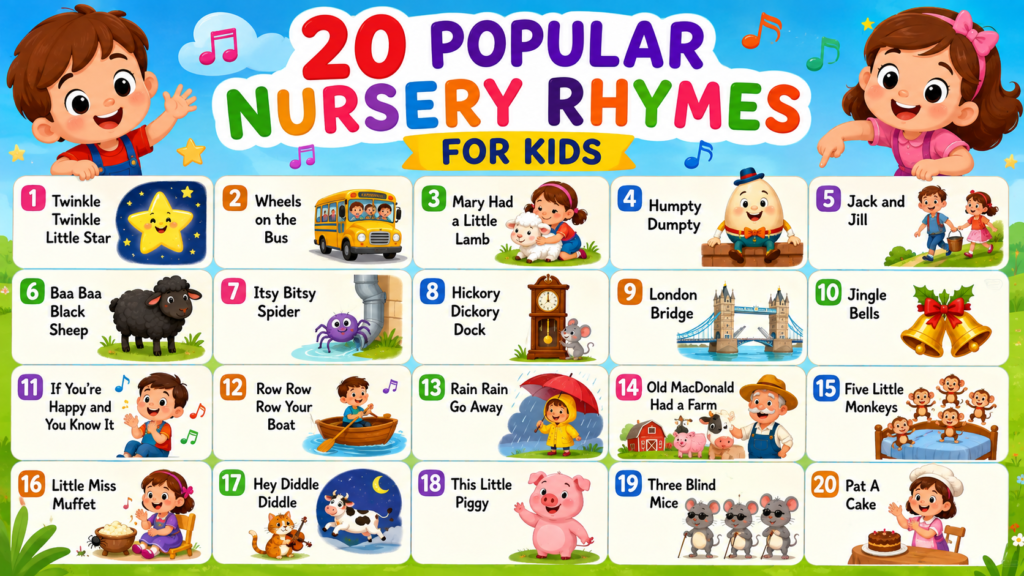
- 20 Popular Nursery Rhymes for Kids
- 1. Twinkle, Twinkle, Little Star
- 2. The Wheels on the Bus
- 3. Baa, Baa, Black Sheep
- 4. Humpty Dumpty
- 5. Jack and Jill
- 6. Rain, Rain, Go Away
- 7. Old MacDonald Had a Farm
- 8. Hickory Dickory Dock
- 9. Row, Row, Row Your Boat
- 10. Five Little Ducks
- 11. If You're Happy and You Know It
- 12. Mary Had a Little Lamb
- 13. Itsy Bitsy Spider
- 14. One, Two, Buckle My Shoe
- 15. Pat-a-Cake
- 16. Teddy Bear, Teddy Bear
- 17. Hey Diddle Diddle
- 18. This Little Piggy
- 19. Ten in the Bed
- 20. Hot Cross Buns
- How to Teach Nursery Rhymes to Young Children
- Fun Activities Using Nursery Rhymes
- Nursery Rhymes at Home vs Preschool
- How Long Should a Nursery Rhyme Session Be?
- Common Mistakes Parents Should Avoid
- How Nursery Rhymes Support Preschool Learning
- Why Nursery Rhymes Are a Part of Learning at Krazy Tots International Preschool
- 20 Fun Nursery Rhymes for Kids FAQs
- Final Thoughts
What Are Nursery Rhymes?
Nursery rhymes are short songs, poems, or verses that are traditionally enjoyed by young children. They usually have simple words, repetition, rhythm, and actions that make them easy to remember.
Children can enjoy nursery rhymes while:
- Singing with parents
- Playing with friends
- Moving and dancing
- Acting out stories
- Learning numbers
- Practicing new words
This is why nursery rhymes fit naturally into early childhood learning.
Why Are Nursery Rhymes Important for Children?
Nursery rhymes may look like simple entertainment, but they can support several early learning skills.
1. They Build Language Skills
Repeated words and phrases give children opportunities to hear and practice vocabulary.
For example, a child may learn words related to animals, weather, family, movement, or everyday objects through songs.
2. They Strengthen Memory
Children often remember songs surprisingly quickly. Repetition, rhythm, and predictable sequences help them remember words and actions.
3. They Improve Listening
When children listen for the next word or action in a familiar rhyme, they practice paying attention and following along.
4. They Encourage Movement
Clapping, jumping, tapping, dancing, and hand movements add a physical element to singing.
5. They Build Confidence
A child who is shy about speaking may feel more comfortable joining a group song because everyone is participating together.
6. They Encourage Imagination
Rhymes often introduce children to funny characters, animals, stories, and imaginary situations. These can become starting points for pretend play and storytelling.
20 Popular Nursery Rhymes for Kids
Here are some simple and familiar nursery rhymes that parents and teachers can include in a child’s routine.
1. Twinkle, Twinkle, Little Star
A gentle rhyme that works particularly well during quiet time or before bedtime.
Try this activity: Ask your child to draw stars and talk about what they can see in the night sky.
2. The Wheels on the Bus
This action-filled song encourages children to copy movements such as wheels turning, wipers moving, and doors opening.
Learning idea: Ask children to invent another bus action and demonstrate it.
3. Baa, Baa, Black Sheep
A repetitive rhyme that introduces simple vocabulary and patterns.
Learning idea: Ask your child to name other animals and make their sounds.
4. Humpty Dumpty
This short storytelling rhyme can be used to introduce sequencing and simple storytelling.
Learning idea: Let your child draw Humpty Dumpty and tell you what happened in the story.
5. Jack and Jill
A familiar story rhyme with movement and a simple sequence of events.
Learning idea: Ask your child what happened first, next, and last.
6. Rain, Rain, Go Away
A simple weather-related rhyme that children can connect with their everyday experiences.
Learning idea: Talk about different types of weather and ask your child what they like doing on rainy days.
7. Old MacDonald Had a Farm
Children love joining in with animal sounds.
Learning idea: Let your child choose an animal and make its sound while everyone sings.
8. Hickory Dickory Dock
This rhyme introduces children to the idea of clocks and time in a playful way.
Learning idea: Make a paper clock and practice identifying simple numbers.
9. Row, Row, Row Your Boat
A gentle group song that can be accompanied by simple rowing movements.
Learning idea: Sit facing your child and move your arms together as though you are rowing.
10. Five Little Ducks
This is a useful counting rhyme because children can count down as the ducks disappear and return.
Learning idea: Use five toy animals and physically remove one at a time while counting.
11. If You’re Happy and You Know It
One of the easiest action songs for young children.
Children can:
- Clap
- Stomp
- Nod
- Jump
- Turn around
Learning idea: Let your child create a new action for everyone to copy.
12. Mary Had a Little Lamb
A gentle story-based rhyme that children can easily follow.
Learning idea: Talk about the animal in the song and ask your child to name other farm animals.
13. Itsy Bitsy Spider
This rhyme is especially fun when children use their fingers to act like a climbing spider.
Learning idea: Make simple spider movements with your hands while singing.
14. One, Two, Buckle My Shoe
A classic counting rhyme that helps children practice number sequences.
Learning idea: Count everyday objects such as toys, blocks, or crayons together.
15. Pat-a-Cake
This is a simple clapping rhyme that parents and children can enjoy together.
Learning idea: Add different clapping patterns and let your child copy them.
16. Teddy Bear, Teddy Bear
An action-based rhyme that encourages children to follow simple instructions.
Learning idea: Ask children to turn, jump, touch the ground, or stretch according to the song.
17. Hey Diddle Diddle
This imaginative rhyme introduces children to unusual characters and funny situations.
Learning idea: Ask your child to create their own silly story involving an animal.
18. This Little Piggy
This playful rhyme is perfect for one-on-one interaction with younger children.
Learning idea: Use finger movements while saying the rhyme and let your child copy you.
19. Ten in the Bed
A counting-down rhyme that can be acted out with toys or stuffed animals.
Learning idea: Place ten toys together and count backward as each one moves away.
20. Hot Cross Buns
A short and rhythmic song that is easy for beginners to learn.
Learning idea: Tap the rhythm using your hands or simple percussion instruments.
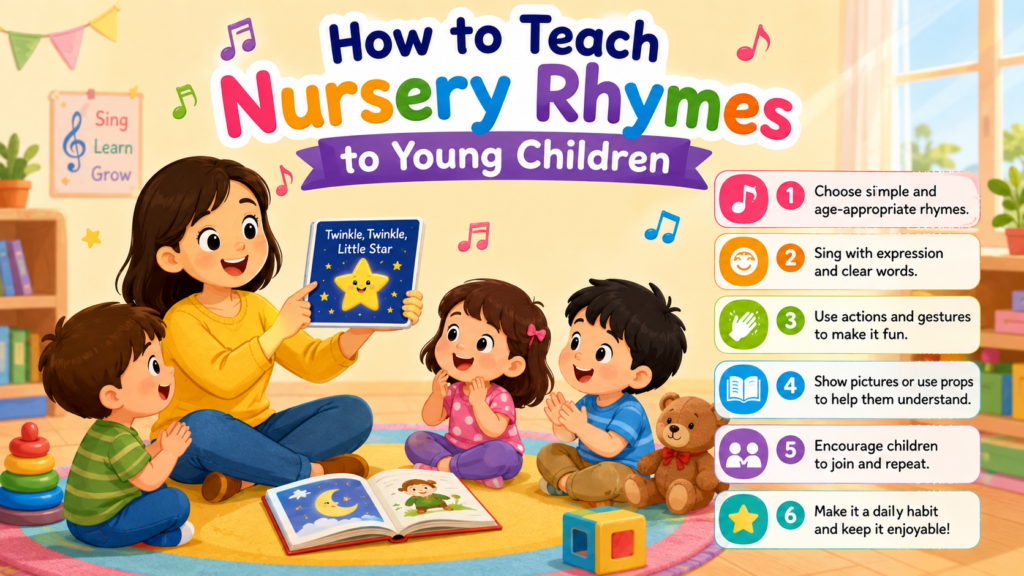
How to Teach Nursery Rhymes to Young Children
You don’t need a complicated lesson plan. A few simple techniques can make rhymes much more enjoyable.
Use Actions
Don’t just sing. Move along with the words.
If the rhyme says “clap,” clap. If it says “jump,” jump.
Children often remember a word more easily when they connect it with an action.
Use Props
Props can make songs more interesting.
Try:
- Toy animals
- Puppets
- Blocks
- Balls
- Picture cards
- Stuffed toys
For example, use toy ducks while singing a counting rhyme.
Repeat Favourite Rhymes
Children often ask for the same song again and again.
That’s perfectly fine.
Repetition gives children more opportunities to recognize words, predict what comes next, and participate independently.
Let Children Lead
Once your child knows a rhyme, let them take over.
Ask:
“Which song should we sing next?”
You can also let them choose the actions.
This turns a simple song into an opportunity for decision-making and confidence building.
Fun Activities Using Nursery Rhymes
Nursery rhymes don’t have to stop when the song ends.
Try these simple activities.
Rhyme and Drawing
After singing a rhyme, ask your child to draw something they remember.
Rhyme and Movement
Create actions for each line of a song.
Rhyme and Counting
Use toys to act out counting songs.
Rhyme and Role Play
Let children pretend to be animals or characters from a rhyme.
Rhyme and Art
Create simple crafts related to the song.
For example, make paper ducks after singing a counting rhyme.
Nursery Rhymes at Home vs Preschool
At home, parents can use rhymes during everyday moments such as:
- Morning routines
- Playtime
- Car journeys
- Bath time
- Quiet time
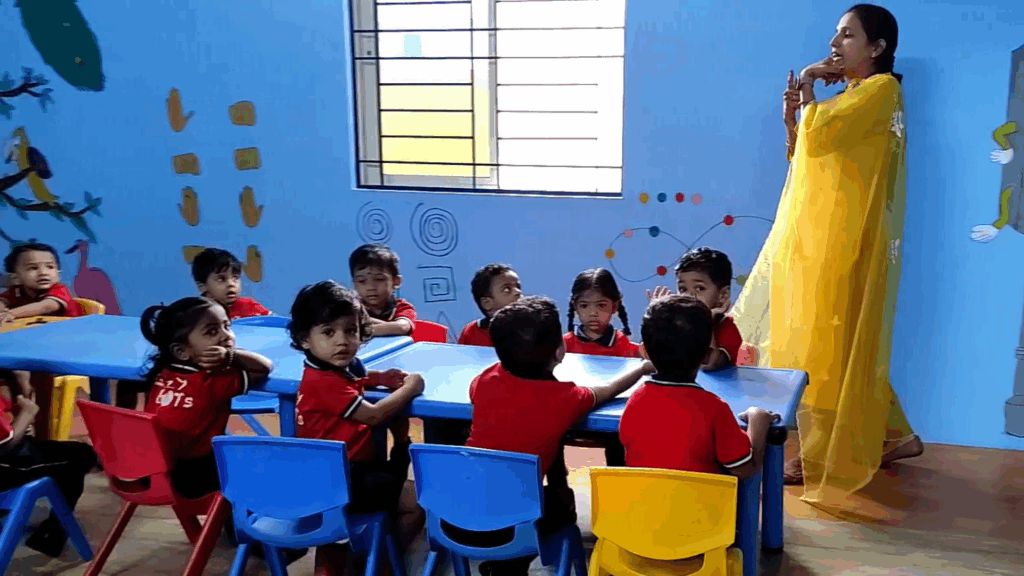
At preschool, rhymes can become part of group learning.
Children can sing together, copy movements, take turns, and participate in activities. This makes nursery rhymes a simple way to combine language, movement, music, and social interaction.
How Long Should a Nursery Rhyme Session Be?
Young children don’t need long sessions.
A short, enjoyable session is often enough.
The goal isn’t to make children sit still and memorize several songs. The goal is to help them participate, move, listen, and enjoy learning.
If your child loses interest, change the activity or take a break.
Common Mistakes Parents Should Avoid
Don’t Force Memorization
If your child doesn’t remember all the words, don’t worry.
Enjoying the song is more important than getting every word right.
Don’t Correct Every Mistake
Children may change words, create new endings, or sing completely different versions.
That’s part of the fun.
Don’t Rely Only on Videos
Videos can be useful, but singing together gives children opportunities to interact, move, and communicate.
Don’t Choose Rhymes That Are Too Difficult
Start with simple songs that match your child’s age and interests.
How Nursery Rhymes Support Preschool Learning
Nursery rhymes can complement several areas of early learning.
Language: Children hear and practice new words.
Early mathematics: Counting songs introduce numbers and sequences.
Physical development: Actions support movement and coordination.
Social development: Group singing encourages participation and turn-taking.
Creativity: Children can draw, act, dance, and create their own versions.
Confidence: Participating in familiar songs can encourage children to speak and perform in front of others.
Why Nursery Rhymes Are a Part of Learning at Krazy Tots International Preschool
At Krazy Tots International Preschool in Horamavu, Bengaluru, we believe early learning should feel natural and enjoyable.
Songs, movement, storytelling, creative activities, and play can give children opportunities to learn while having fun. Our experienced teachers use age-appropriate activities to support children’s language, confidence, creativity, social skills, and physical development.
With a spacious campus, large covered play area, experienced teachers, and programs for Nursery, LKG, UKG, and daycare, we aim to create an environment where children feel comfortable exploring and learning.
20 Fun Nursery Rhymes for Kids FAQs
Which nursery rhymes are best for preschoolers?
Simple rhymes with repetition, actions, counting, animals, and familiar everyday ideas are usually good choices for preschool-aged children.
What do children learn from nursery rhymes?
Nursery rhymes can support language, vocabulary, memory, listening, rhythm, movement, social interaction, and confidence.
Should children memorize nursery rhymes?
Memorization shouldn’t be the main goal. Children can learn naturally through repetition, singing, actions, and regular participation.
How can I make nursery rhymes more fun?
Add actions, toys, puppets, drawing, dancing, role play, or simple counting activities related to the rhyme.
Can nursery rhymes help with language development?
Yes. Singing repeated words and phrases gives young children opportunities to hear sounds, learn vocabulary, practice pronunciation, and participate in conversations.
Final Thoughts
Nursery rhymes are much more than little songs that children sing repeatedly. They can turn ordinary moments into opportunities for language, movement, imagination, memory, and connection.
The best part is that you don’t need expensive toys or complicated activities. Your voice, a few simple actions, and your child’s imagination are enough to get started.
So pick a favourite rhyme, sing together, clap along, and let your child have fun. Those simple moments can become meaningful parts of their early learning journey.
If you’re looking for a preschool where learning through play, music, movement, and hands-on activities is part of the daily experience, visit Krazy Tots International Preschool in Horamavu, Bengaluru and explore the learning environment for yourself.