Montessori vs Traditional Preschool
Which One Is Right for Your Child?
Choosing the right preschool is one of the most important decisions parents make during their child’s early years. Many parents often compare Montessori preschool and traditional preschool to decide which learning environment will benefit their child the most.
Montessori preschools focus on child-led learning, independence, and hands-on exploration, while traditional preschools follow a structured curriculum with teacher-led activities and group learning. Both approaches help children develop early skills, but the right choice depends on your child’s personality, learning style, and educational goals.
At Krazy Tots International Preschool in Horamavu, Bengaluru, we believe that the best early education blends structured learning with play-based exploration so children grow academically, socially, and emotionally.
- Quick Comparison: Montessori vs Traditional Preschool
- Understanding Montessori Preschool Education
- Understanding Traditional Preschool Education
- Montessori vs Traditional Preschool: Key Differences
- Which Preschool Approach Is Better?
- Why Preschool Education Is Important
- Choosing the Right Preschool for Your Child
- Why Many Parents Choose Krazy Tots International Preschool in Horamavu
- montessori-vs-traditional-preschool Final Thoughts
- montessori-vs-traditional-preschool FAQs
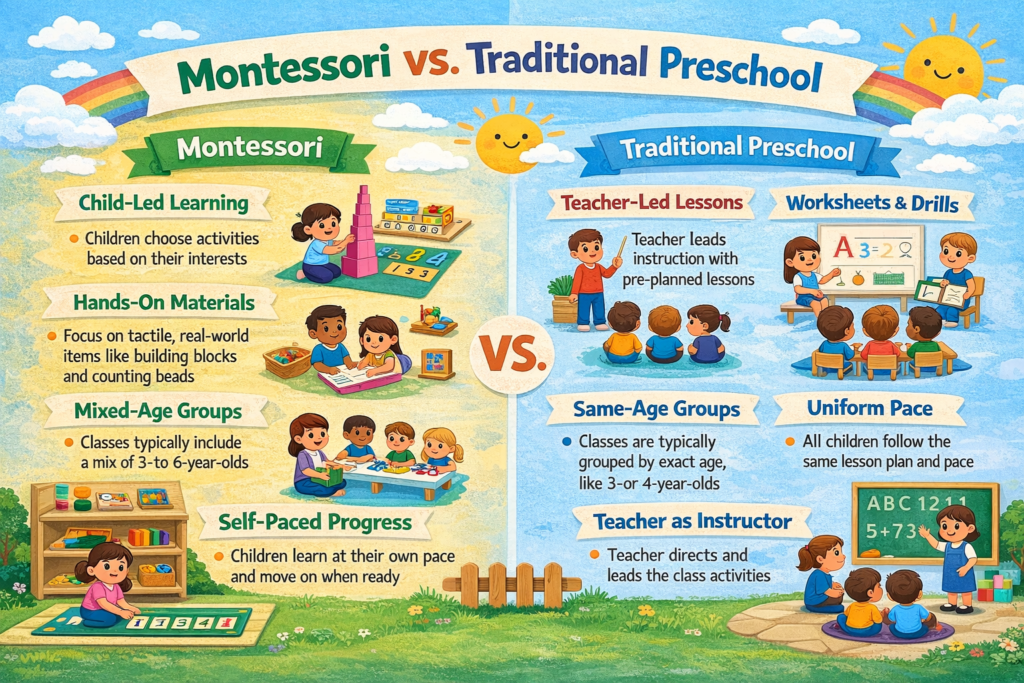
Quick Comparison: Montessori vs Traditional Preschool
| Feature | Montessori Preschool | Traditional Preschool |
|---|---|---|
| Learning Style | Child-led learning | Teacher-led learning |
| Classroom Structure | Mixed age groups (3–6 years) | Same-age classrooms |
| Teaching Approach | Hands-on materials | Structured lessons |
| Role of Teacher | Guide or facilitator | Instructor or leader |
| Pace of Learning | Individual pace | Same pace for whole class |
| Activities | Self-chosen activities | Scheduled activities |
| Goal | Independence and curiosity | School readiness |
Both models support early development but differ in how children experience learning.
Understanding Montessori Preschool Education
Montessori education was developed by Dr. Maria Montessori, who believed children learn best when they explore their environment and follow their natural curiosity.
The Montessori approach focuses on:
- Independence
- Hands-on learning
- Self-discovery
- Confidence building
In Montessori classrooms, children choose activities from specially designed learning materials that help them understand concepts through touch and exploration.
Key Features of Montessori Learning
1. Child-Led Learning
Children choose activities that interest them and work at their own pace. This helps them stay engaged and motivated.
2. Mixed-Age Classrooms
Montessori classrooms usually include children aged 3 to 6 years, allowing younger children to learn from older peers while older children develop leadership skills.
3. Specialized Learning Materials
Montessori classrooms use materials designed to help children learn through experience. These tools allow children to identify mistakes and correct them independently.
4. Teachers as Guides
Teachers observe children and introduce learning materials when they are ready rather than directing every activity.
Understanding Traditional Preschool Education
Traditional preschools follow a structured curriculum where teachers guide activities and lessons.
This model is closer to the learning style children experience in primary school.
Key Features of Traditional Preschool
1. Teacher-Led Learning
Teachers plan lessons and guide children through activities such as:
- Circle time
- Art projects
- Storytime
- Alphabet practice
2. Age-Based Classrooms
Children are grouped by age, and everyone works on similar activities at the same time.
3. Structured Daily Schedule
A typical preschool day may include:
- Morning circle time
- Learning activities
- Snack break
- Outdoor play
- Creative activities
Structured routines help children develop discipline and prepare for primary school.
4. Focus on School Readiness
Traditional preschools emphasize early literacy, numbers, and classroom behavior.
Montessori vs Traditional Preschool: Key Differences
Understanding the differences between these approaches can help parents choose the best option.
Learning Approach
Montessori classrooms allow children to explore activities based on interest and curiosity, while traditional preschools follow a set schedule guided by the teacher.
Classroom Environment
Montessori classrooms are calm, organized, and designed for independent exploration.
Traditional classrooms often include colorful decorations, group learning stations, and teacher-led lessons.
Assessment Style
Montessori schools evaluate children through observation and progress tracking.
Traditional preschools may use worksheets, tests, and activity assessments to measure progress.
Which Preschool Approach Is Better?
There is no single answer because every child learns differently.
Montessori programs work well for children who:
- Enjoy independent exploration
- Like hands-on learning
- Are naturally curious
Traditional preschools may be better for children who:
- Prefer structured routines
- Enjoy group activities
- Thrive with teacher guidance
Both approaches can support healthy development when delivered by experienced educators.
Why Preschool Education Is Important
Regardless of the teaching approach, preschool plays a vital role in early childhood development.
Preschool helps children develop:
- Communication skills
- Social interaction
- Emotional confidence
- Problem-solving abilities
- Creativity
- Physical coordination
Research shows that early childhood education significantly improves school readiness and long-term learning outcomes.
Choosing the Right Preschool for Your Child
When choosing a preschool, parents should consider several factors.
1. Your Child’s Learning Style
Observe how your child learns best. Some children prefer structured activities, while others enjoy exploring independently.
2. Teaching Philosophy
Understand the preschool’s educational philosophy and how teachers interact with children.
3. Learning Environment
Look for a safe and stimulating environment that encourages exploration and creativity.
4. Teacher Experience
Experienced teachers play a crucial role in supporting children’s development.
5. Facilities and Space
Children need space for physical activity, creative play, and exploration.
Why Many Parents Choose Krazy Tots International Preschool in Horamavu
At Krazytots International Preschool, we combine the best aspects of structured learning and play-based exploration.
Our preschool provides:
- Spacious open campus
- Covered play areas
- Large outdoor playground
- Safe and nurturing classrooms
- Experienced teachers
- Activity-based learning programs
- Affordable preschool fees
This balanced approach helps children develop confidence, creativity, and strong learning foundations.
Parents searching for a trusted preschool in Horamavu often choose Krazytots because it provides a supportive environment where children feel happy and excited to learn.
montessori-vs-traditional-preschool Final Thoughts
Both Montessori and traditional preschool models offer valuable benefits for young learners.
Montessori education emphasizes independence and exploration, while traditional preschool focuses on structured learning and school readiness.
The best choice depends on your child’s personality, learning style, and your family’s educational goals.
A high-quality preschool with caring teachers and engaging activities will help your child develop the skills needed for lifelong learning.
If you are looking for a nurturing preschool in Horamavu, Krazy Tots International Preschool provides a safe and engaging environment where children can learn, grow, and thrive.
montessori-vs-traditional-preschool FAQs
What is the main difference between Montessori and traditional preschool?
Montessori preschools focus on child-led learning and independence, while traditional preschools follow structured teacher-led lessons and group activities.
Which preschool method is better for children?
Both Montessori and traditional preschools can be beneficial. The best option depends on your child’s learning style and developmental needs.
At what age should a child start preschool?
Most children start preschool between 2.5 and 3 years old, depending on their readiness and the preschool program.
Does Montessori help children become independent?
Yes. Montessori education encourages independence by allowing children to choose activities and solve problems on their own.
How do I choose the best preschool?
Parents should consider the preschool’s teaching philosophy, teacher experience, safety, facilities, and learning environment.